Have you ever felt “too fiery,” “stuck in the mud,” or like you’re “going with the flow”? These phrases aren’t just poetic — they reflect one of the most powerful energetic systems in Chinese metaphysics: the Five Elements.
Far more than abstract theory, the Five Elements in Chinese Metaphysics — Wood, Fire, Earth, Metal, and Water — are foundational forces that shape our health, personality, relationships, destiny, and environment. They influence ancient systems like Bazi (Four Pillars of Destiny), Feng Shui, Qimen Dun Jia, and Traditional Chinese Medicine (TCM).
In this article, we’ll explore the meaning, relationships, and real-life application of the Five Elements so you can use this knowledge to create alignment in your inner and outer world.

What Are the Five Elements in Chinese Metaphysics?
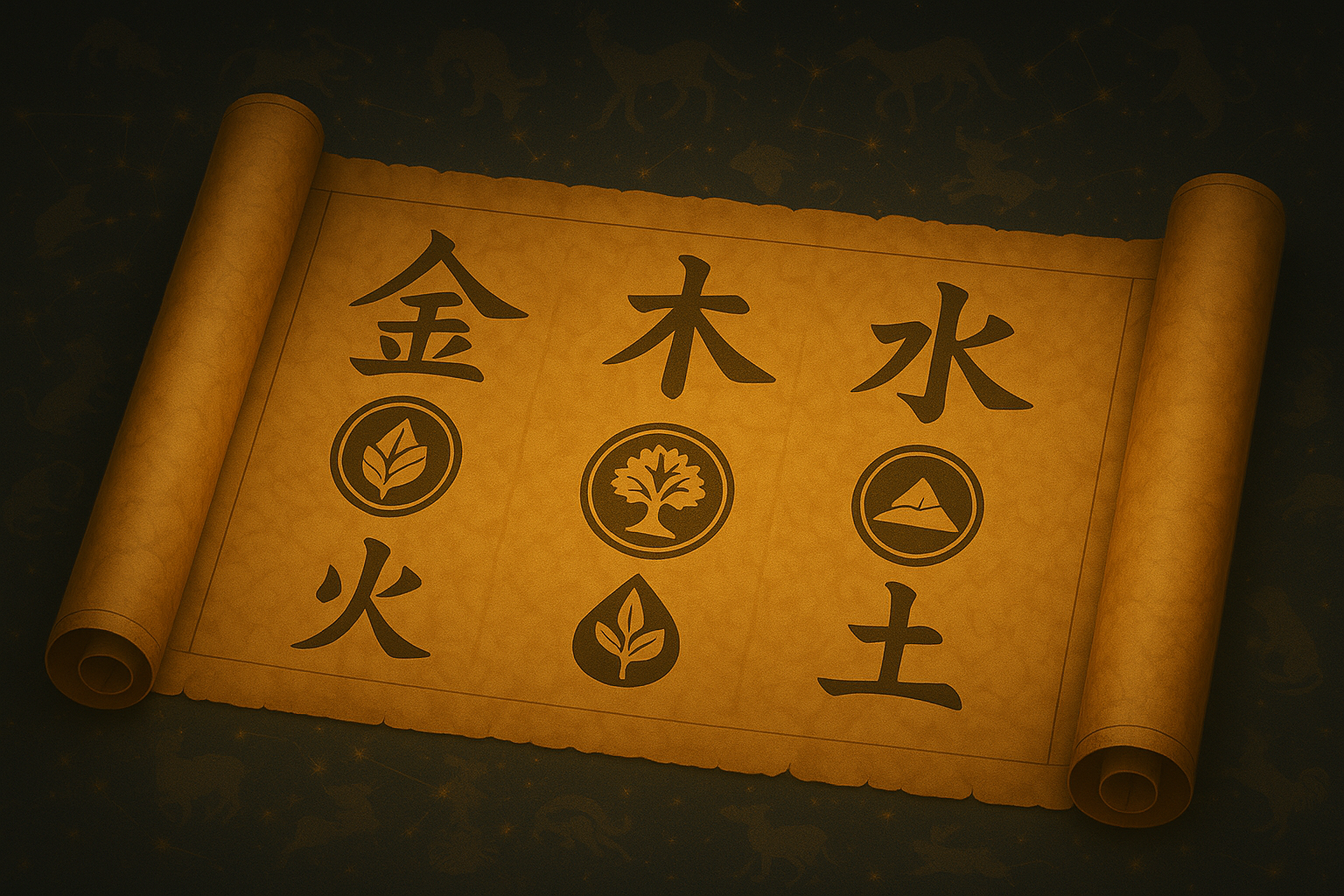
The Five Elements (五行, Wu Xing) represent cyclical patterns of energy and transformation. Each element is more than just a symbol — it embodies a dynamic quality of life, nature, and human experience.
| Element | Quality | Season | Emotion | Organ | Direction | Color |
| Wood | Growth, flexibility | Spring | Anger | Liver | East | Green |
| Fire | Passion, expansion | Summer | Joy | Heart | South | Red |
| Earth | Nurturing, stability | Late Summer | Worry | Spleen | Centre | Yellow |
| Metal | Precision, structure | Autumn | Grief | Lungs | West | White |
| Water | Wisdom, adaptability | Winter | Fear | Kidneys | North | Blue/Black |
In TCM and wellness, these elements connect all aspects of well-being—from diet and emotions to organ function—centering health in balance (ACA Acupuncture & Wellness, Healthline).
The Elemental Cycles: Flow and Balance
The Five Elements interact through two primary cycles:
Generating (Sheng) Cycle
This cycle represents how elements support one another:
- Wood feeds Fire (think: wood burning in a fire)
- Fire creates Earth (ash returns to the soil)
- Earth produces Metal (minerals form in the earth)
- Metal enriches Water (minerals in water nourish life)
- Water nourishes Wood (plants need water to grow)
This is a harmonious, creative flow — essential for growth and synergy.
Controlling (Ke) Cycle
This cycle regulates and keeps each element in check:
- Wood penetrates Earth (roots breaking ground)
- Earth blocks Water (soil absorbs and redirects)
- Water extinguishes Fire
- Fire melts Metal
- Metal cuts Wood
This cycle is about correction, structure, and control. It prevents imbalance.
When your life feels chaotic, it may be that one element is too strong or too weak — disrupting the flow between these cycles.
How Does Five Elements in Metaphysics Show Up in Your Life
1. In Your Bazi Chart
Each person is born with a combination of elements based on their year, month, day, and hour of birth. Your dominant element (Day Master) reveals your personality and the balance of elements shows your life dynamics — challenges, strengths, timing of events.
👉 Learn more: What Is Bazi? A Practical Guide to the Four Pillars of Destiny
2. In Feng Shui
Each area of your home corresponds to an element (e.g. the South area is Fire). You can adjust your space by using elemental colors, materials, and shapes to harmonize energy and correct imbalances.
For example:
- A home with too much Water energy might feel cold and isolating.
- A Fire-deficient space may feel dull or uninspired.
- You can add red accents, lights, or triangular shapes to enhance Fire.
3. In Traditional Chinese Medicine (TCM)
Your physical and emotional health are seen through an elemental lens:
- Liver imbalances (Wood) → frustration, rigidity
- Heart imbalances (Fire) → anxiety, restlessness
- Spleen imbalances (Earth) → overthinking, heaviness
- Lung imbalances (Metal) → sadness, grief
- Kidney imbalances (Water) → fear, low vitality
A good TCM practitioner will often ask about emotions, diet, and even sleep patterns to detect which elements are overactive or deficient.
4. In Relationships
People embody different elemental energies:
- Wood people are visionary and proactive but may be impatient.
- Fire types are charismatic and passionate but can burn out quickly.
- Earth types are nurturing and reliable but may get stuck in routine.
- Metal types are refined and organized but may become too rigid.
- Water types are wise and adaptable but can withdraw or become fearful.
Compatibility between people often depends on how these elements interact. For example:
- Fire (excitement) can feel drained by Water (calm)
- Wood (vision) may clash with Metal (structure)
Signs of Elemental Imbalance
Too much or too little of an element can cause disruptions in your physical health, emotions, or life flow.
- Excess Wood: Anger, impulsiveness, feeling scattered
- Weak Fire: Lack of passion, poor circulation, emotional coldness
- Overactive Earth: Clinginess, worry, digestive issues
- Too much Metal: Rigid thinking, judgment, breathing issues
- Low Water: Fearfulness, lack of direction, burnout
You can balance these through:
- Food (warm foods for Fire, grounding foods for Earth)
- Colors (wearing blue for Water energy, red for Fire)
- Environment (changing decor, Feng Shui cures)
- Lifestyle (slowing down if you’re too Fire, or moving more if you lack Wood)
Living in Elemental Harmony
The Five Elements aren’t static — they’re always in motion, just like you. Understanding them allows you to:
- Recognize energetic patterns in yourself and others
- Align your lifestyle with seasonal and emotional cycles
- Make better decisions with clarity and timing
It’s not about “fixing” yourself — it’s about balancing the flow so you can live with more awareness, ease, and power.
For deeper guidance, see:
👉 What Is Metaphysical Alignment (And Why It Matters More Than Ever)
Your Next Step
The wisdom of the Five Elements is ancient, but its relevance is timeless. Whether you’re navigating a life transition, choosing your next move, or simply seeking to understand yourself, this elemental lens offers a clear and elegant framework.
In the language of Chinese metaphysics, balance isn’t a destination — it’s a rhythm. And once you learn to dance with the elements, life begins to flow in remarkable ways.
🔍 Ready to discover which element dominates your chart? Try our free Bazi Report.
Coming soon: Kailume’s interactive Five Element quiz.